New Noida is one of the most significant upcoming development projects in the Delhi-NCR region. Officially known as the Dadri-Noida-Ghaziabad Investment Region (DNGIR), the project is being planned as a large-scale industrial, commercial and urban development region under the long-term vision of the Noida Master Plan 2041.
Unlike a conventional private real estate project, New Noida is not being developed by a single builder. The project is being planned and implemented under the Noida Authority, with a strong focus on industrial development, logistics, employment generation and supporting residential and commercial infrastructure.
The planned region covers approximately 209.11 sq. km. and the 2024 approved framework described development across 80 villages, while subsequent government reporting has also referred to an 84-village notified area. The current implementation is phased, with 37 villages identified for the first phase of land acquisition in 2026.
With around 40% of the planned land earmarked for industrial use, New Noida could eventually become an important manufacturing, logistics and business destination in the NCR.
What Is New Noida?
New Noida is the commonly used name for the Dadri-Noida-Ghaziabad Investment Region (DNGIR).
The idea behind the project is to create a new economic and industrial growth centre beyond the existing developed areas of Noida. The existing city has already developed into a major corporate, IT, commercial and residential destination, but availability of large land parcels for future industrial expansion is becoming increasingly limited.
New Noida is therefore being planned with a different approach.
Instead of focusing primarily on residential development, the project gives significant importance to:
- Industrial development
- Manufacturing
- Logistics
- Warehousing
- Commercial activities
- Institutional development
- Residential areas
- Green and recreational spaces
- Employment generation
- Supporting infrastructure
The Uttar Pradesh government's investment material describes New Noida as a planned development spread across approximately 209.11 sq. km.
The long-term vision is to create an integrated economic region where businesses and the workforce can operate within a planned urban ecosystem.
Why Is New Noida Being Developed?
The development of New Noida is closely connected with the future expansion requirements of the NCR economy.
Noida has already established itself as a major destination for IT companies, corporate offices, manufacturing, commercial real estate Investment and residential development. As the city matures, the availability of large parcels for new industries becomes more limited.
New Noida can provide a new land bank for businesses that require substantial space.
Major objectives behind New Noida include:
- Expanding industrial capacity in NCR
- Attracting domestic and international investment
- Creating employment opportunities
- Developing logistics and warehousing infrastructure
- Supporting manufacturing industries
- Providing planned residential development
- Creating new commercial centres
- Improving regional connectivity
- Supporting long-term economic growth
The planned city is expected to accommodate around 6 lakh residents, which means that the development is not expected to be limited to factories and industrial units. Housing, retail, education, healthcare and other social infrastructure will also be required.
Where Is New Noida Located?
New Noida is being developed around the Dadri-Sikandrabad region, covering parts of Gautam Buddh Nagar and Bulandshahr.
Its location is one of the major factors behind the project's potential.
The region sits within the wider economic ecosystem of:
- Noida
- Greater Noida
- Ghaziabad
- Dadri
- Bulandshahr
- Yamuna Expressway region
- Noida International Airport region
This location provides potential access to major road, rail and freight networks.
For industries, this connectivity can be particularly important because transportation costs and supply-chain efficiency directly influence business operations.
How Many Villages Are Included in New Noida?
This is one of the most commonly searched questions about New Noida Master Plan 2041.
The approved 2024 planning framework described New Noida as covering 80 villages:
|
District |
Villages |
|
Gautam Buddh Nagar |
20 |
|
Bulandshahr |
60 |
|
Total |
80 |
The same government-backed material states that the DNGIR would be developed across 20 villages of Gautam Buddh Nagar and 60 villages of the Secunderabad tehsil area of Bulandshahr.
However, later government reporting has referred to an 84-village notified area. This means readers should not assume that every source published at different stages will show the same village count. For any property or land transaction, the latest official notification and village-wise planning records should be checked.
What is happening now?
The entire New Noida area is not being acquired simultaneously.
In the latest 2026 implementation update, the first phase covers 37 villages:
- 13 villages in Gautam Buddh Nagar
- 24 villages in Bulandshahr
The first-phase survey and acquisition process involves verification of land records, ownership details, inheritance claims, boundaries, existing land use, crops, structures and other assets.
This phased approach is important because it shows that New Noida is gradually moving from the planning stage toward actual implementation.
New Noida Master Plan 2041
The New Noida Master Plan 2041 provides the long-term framework for the development of DNGIR.
The project is planned to be developed in multiple phases rather than all at once.
|
Development Phase |
Planned Area |
Target Period |
|
Phase 1 |
3,165 hectares |
Up to 2027 |
|
Phase 2 |
3,798 hectares |
2027–2032 |
|
Phase 3 |
5,908 hectares |
2032–2037 |
|
Phase 4 |
8,230 hectares |
2037–2041 |
The first phase is intended to establish the initial industrial and urban infrastructure, while subsequent phases will progressively expand the developed area.
This phased approach also means that investors should understand that New Noida in 2026 is not the same as the fully developed New Noida envisioned for 2041.
What Will Be Built in New Noida?
The biggest attraction of New Noida is its planned mixed-use economic structure.
The development is expected to include:
Industrial Zones
Large industrial areas will be created for manufacturing, production and related businesses.
Logistics & Warehousing
Warehouses, logistics centres and freight-related facilities can support industries operating in the region.
Commercial Areas
Commercial zones can accommodate offices, retail, business services, restaurants and other supporting activities.
Residential Areas
Residential development will support workers, professionals and families living around the industrial and commercial ecosystem.
Institutional Development
Educational, training and other institutional facilities will be required to support the growing population and workforce.
Green & Recreational Areas
The Master Plan also includes substantial green and recreational areas, helping create a more planned urban environment.
New Noida Land Use Plan
One of the strongest indicators of New Noida's future identity is its proposed land-use distribution.
|
Land Use |
Approximate Share |
|
Industrial |
40% |
|
Residential |
13% |
|
Green & Recreational |
18% |
|
Commercial |
4% |
|
Institutional |
8% |
|
Other Uses |
Remaining |
The 40% industrial allocation is particularly significant.
It means New Noida is fundamentally being designed as an economic and industrial development region, rather than simply another residential extension of Noida.
This industrial focus could create a multiplier effect.
More industries can lead to:
Jobs → Housing Demand → Retail Demand → Commercial Growth → Services → Higher Economic Activity
Which Industries Could Come to New Noida?
The industrial focus opens opportunities across multiple sectors.
1. Manufacturing
New Noida can provide large land parcels for manufacturing facilities, factories and industrial units.
2. Electronics & Technology
The wider Noida-Greater Noida region has already developed an important electronics and technology ecosystem. New Noida could provide additional space for future expansion.
3. Food Processing & FMCG
Food processing and FMCG are among the sectors identified for industrial opportunities in the wider planning framework.
4. Logistics & Warehousing
The strategic location and freight connectivity could make logistics one of the biggest sectors in New Noida.
5. Automotive & EV Components
The wider NCR industrial ecosystem has attracted automotive and EV-related manufacturing, creating potential opportunities for component manufacturers and ancillary industries.
6. Digital Infrastructure
Data centres, AI infrastructure and technology-driven businesses are growing across Noida and Greater Noida. However, companies should only be described as New Noida investors when their specific project is officially located within DNGIR.
New Noida Infrastructure and Connectivity
Infrastructure will be one of the biggest factors determining the success of New Noida.
The region's potential connectivity advantage comes from its relationship with existing and planned:
- Expressways
- National highways
- Railway infrastructure
- Dedicated freight corridors
- Logistics hubs
- Noida and Greater Noida
- Noida International Airport
The Uttar Pradesh investment ecosystem already identifies Dadri Inland Container Depot, the Western Dedicated Freight Corridor and logistics infrastructure such as the Dadri Multi-Modal Logistics Hub as important regional assets.
This can make New Noida particularly attractive for businesses where transportation and supply-chain efficiency are critical.
New Noida and Delhi-Mumbai Industrial Corridor
The Delhi-Mumbai Industrial Corridor (DMIC) is another major factor behind New Noida's long-term business potential.
DNGIR has been positioned within the wider DMIC investment ecosystem.
The presence of the Western Dedicated Freight Corridor can help industries move raw materials and finished goods more efficiently.
Potential benefits for businesses include:
- Faster freight movement
- Better supply-chain connectivity
- Access to national markets
- Better export logistics
- Lower transportation time
- Improved industrial competitiveness
For manufacturing and logistics companies, these advantages can be more important than simply being close to a major residential market.
New Noida and Noida International Airport
The Noida International Airport at Jewar is another major infrastructure development that can influence the wider region.
New Noida and the airport region are separate planning areas and should not be presented as the same project.
However, their combined growth could create a broader economic ecosystem.
Airport-led development can increase demand for:
- Logistics
- Warehousing
- Cargo services
- Hospitality
- Business travel
- Corporate services
- Manufacturing
- Export-oriented industries
This is particularly relevant for New Noida because the region is being developed around industries and logistics.
Which Companies Are Investing in New Noida?
This is one section where real estate blogs need to be especially careful.
New Noida is still in the land-acquisition and implementation stage, so it would be inaccurate to claim that every major company investing in Noida, Greater Noida or Yamuna Expressway is automatically a New Noida investor.
The broader NCR ecosystem, however, has attracted investments from companies across electronics, manufacturing, automotive, technology and digital infrastructure.
For example, the wider Greater Noida ecosystem has seen investments involving companies such as Haier Electronics, Forme Mobile, Satkriti Infotainment, Chenfeng and J World Electronics in an integrated industrial township.
Similarly, the wider Noida-Greater Noida region is attracting major digital infrastructure proposals, including investments reported by Invest UP from AM Green Group and Sify Technologies.
Important distinction
These companies should not automatically be described as companies investing inside New Noida/DNGIR.
A high-quality informational article should differentiate between:
Confirmed New Noida/DNGIR development
and
Investment in the wider Noida-Greater Noida-YEIDA region.
This avoids misleading readers and makes the article more trustworthy.
Who Is the Builder of New Noida?
New Noida does not have one private builder.
This is an important difference between New Noida and private residential projects.
The project is being planned and implemented under the Noida Authority, with government-led planning and land acquisition.
The Authority's responsibilities include:
- Land acquisition
- Master planning
- Infrastructure development
- Land-use implementation
- External development
- Coordination with government departments
Private developers and businesses may participate in future development through approved land allotments and projects.
Therefore, people searching for “New Noida builder” should understand that New Noida is a planned authority-led development, not a single builder's township.
New Noida Land Acquisition: Latest Update 2026
Land acquisition is currently one of the most important developments to watch.
According to the latest July 2026 update, the Noida Authority is preparing to begin acquisition in 37 villages, with 13 in Gautam Buddh Nagar and 24 in Bulandshahr. Officials are conducting ground-level surveys to verify land records, ownership, inheritance claims, boundaries, existing structures and land use.
This is significant because land acquisition is a key step before large-scale infrastructure development can begin.
Why is land acquisition important?
It enables the Authority to establish:
- Roads
- Industrial plots
- Commercial zones
- Residential sectors
- Utilities
- Green spaces
- Public infrastructure
However, acquisition does not mean that every piece of land in every village will immediately become a commercial or residential project.
The Master Plan's designated land use remains important.
Residential and Commercial Development in New Noida
Although industry is the primary focus, New Noida will also require substantial residential and commercial infrastructure.
The Master Plan allocates approximately 13% of the planned land for residential development and 4% for commercial use.
This could eventually create demand for:
- Apartments
- Plotted developments
- Rental housing
- Retail shops
- Offices
- Business centres
- Restaurants
- Schools
- Healthcare facilities
However, investors should differentiate between planned land use and an officially launched private project.
Just because an area falls within the New Noida planning region does not mean every plot or property being marketed there is legally approved for development.
New Noida Investment Potential
The long-term investment story of New Noida is primarily based on infrastructure + industrialisation + connectivity + employment.
Potential investment segments could include:
|
Segment |
Potential Growth Driver |
|
Industrial Land |
Manufacturing expansion |
|
Warehousing |
Logistics and e-commerce |
|
Commercial Property |
Business activity |
|
Retail |
Population growth |
|
Residential |
Employment generation |
|
Rental Property |
Workforce demand |
|
Support Services |
Industrial ecosystem |
Why investors are watching New Noida
- Large planned development area
- Industrial-focused Master Plan
- DMIC ecosystem
- Freight connectivity
- Proximity to major NCR markets
- Noida International Airport ecosystem
- Long-term development horizon up to 2041
But investors should remember that higher potential also comes with higher development-stage risk.
Before purchasing land or property, check:
- Ownership and title
- Exact village
- Survey number
- Current land use
- Master Plan zoning
- Acquisition status
- Development authority approvals
- RERA registration, where applicable
- Road connectivity
- Mutation and revenue records
- Seller's legal right to sell
Do not rely solely on phrases such as “New Noida upcoming project”, “New Noida approved plot” or “New Noida authority approved property” without checking official documentation.
New Noida vs Existing Noida
|
Factor |
Existing Noida |
New Noida |
|
Development Stage |
Mature |
Emerging |
|
Main Character |
IT, Commercial, Residential |
Industrial, Logistics, Economic |
|
Land Availability |
Relatively Limited |
Large Planned Area |
|
Industrial Potential |
Established |
Major Future Focus |
|
Commercial Market |
Mature |
Developing |
|
Infrastructure |
Developed |
Under Development |
|
Investment Profile |
Established Market |
Long-Term Growth Market |
|
Development Horizon |
Existing City |
Planned Up to 2041 |
Existing Noida offers the advantage of established infrastructure and mature commercial activity.
New Noida, on the other hand, offers a longer development cycle and larger planned industrial ecosystem.
This makes the two markets different rather than direct substitutes.
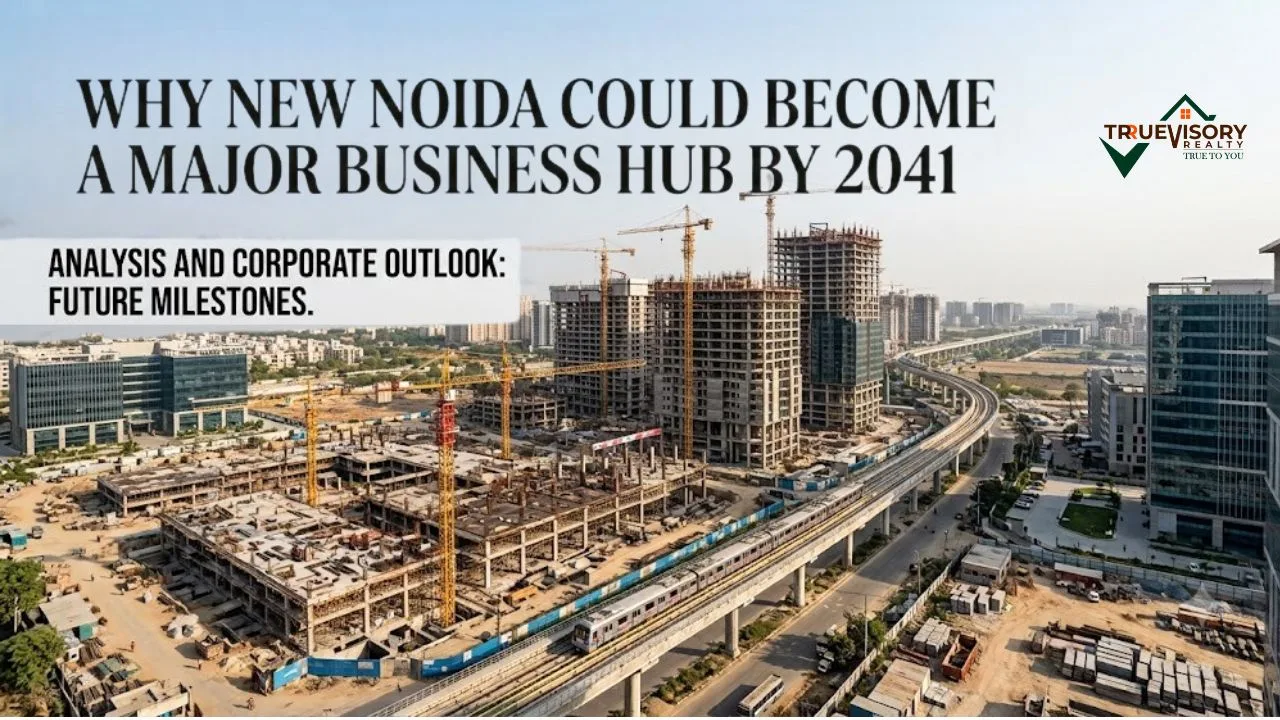
Why New Noida Could Become a Major Business Hub by 2041
There are several reasons why New Noida could emerge as a major business hub.
1. Large Industrial Land Allocation
With approximately 40% of planned land allocated to industry, the project has a strong economic foundation.
2. Strategic Location
Its location connects multiple important NCR economic zones.
3. Freight Connectivity
The DMIC and freight-corridor ecosystem can support manufacturing and logistics.
4. Airport Connectivity
The wider Noida International Airport region can support international business and logistics activity.
5. Employment Generation
Large-scale industries can generate direct employment while supporting thousands of indirect jobs opportunity in Noida.
6. Planned Development
Unlike organic urban expansion, New Noida is being planned through a structured Master Plan.
7. Long-Term Vision
The development horizon extends to 2041, allowing infrastructure, industries and residential areas to grow progressively.
Key Takeaways
- New Noida is the popular name for DNGIR — Dadri-Noida-Ghaziabad Investment Region.
- It is being developed under the Noida Authority, not by a single private builder.
- The planned area is approximately 209.11 sq. km.
- The 2024 framework described 80 villages, while later government reporting has referred to 84; the latest official notification should be checked for specific land.
- The latest 2026 acquisition phase covers 37 villages.
- Around 40% of planned land is earmarked for industrial development.
- Residential development accounts for approximately 13%.
- Green and recreational areas account for around 18%.
- New Noida is expected to support around 6 lakh residents.
- Manufacturing, logistics, warehousing, FMCG, food processing and technology could be important sectors.
- DNGIR's relationship with the DMIC and freight infrastructure is a major potential advantage.
- New Noida and Noida International Airport are separate planning areas but can benefit from the wider regional growth.
- New Noida is an authority-led planned development, not a single private-builder township.
- Land acquisition and implementation are now becoming the key focus areas.
Conclusion
New Noida could become one of the most important emerging economic regions of Delhi-NCR by 2041.
Its significance comes from more than just its size. The combination of a 209.11 sq. km. planned area, large industrial land allocation, freight connectivity, DMIC ecosystem, proximity to Noida International Airport and long-term infrastructure planning gives New Noida the potential to develop into a major industrial and business destination.
The current phase is particularly important because the project is gradually moving from planning toward implementation. The identification of 37 villages for the first phase of land acquisition in 2026 represents an important step in translating the Master Plan into actual development.
At the same time, investors should avoid treating every plot, builder project or land parcel marketed under the name “New Noida” as officially approved. New Noida is a large authority-led planning region, and its development will happen in phases.
For businesses, the region could offer new opportunities in manufacturing, logistics, warehousing, technology, FMCG, food processing and supporting services. For the real estate sector, industrialisation and employment generation could eventually create demand for residential, commercial and retail properties.
If infrastructure development, land acquisition and industrial investment progress according to the planned roadmap, New Noida has the potential to evolve from a planned investment region into a major industrial, logistics and commercial hub of Uttar Pradesh by 2041