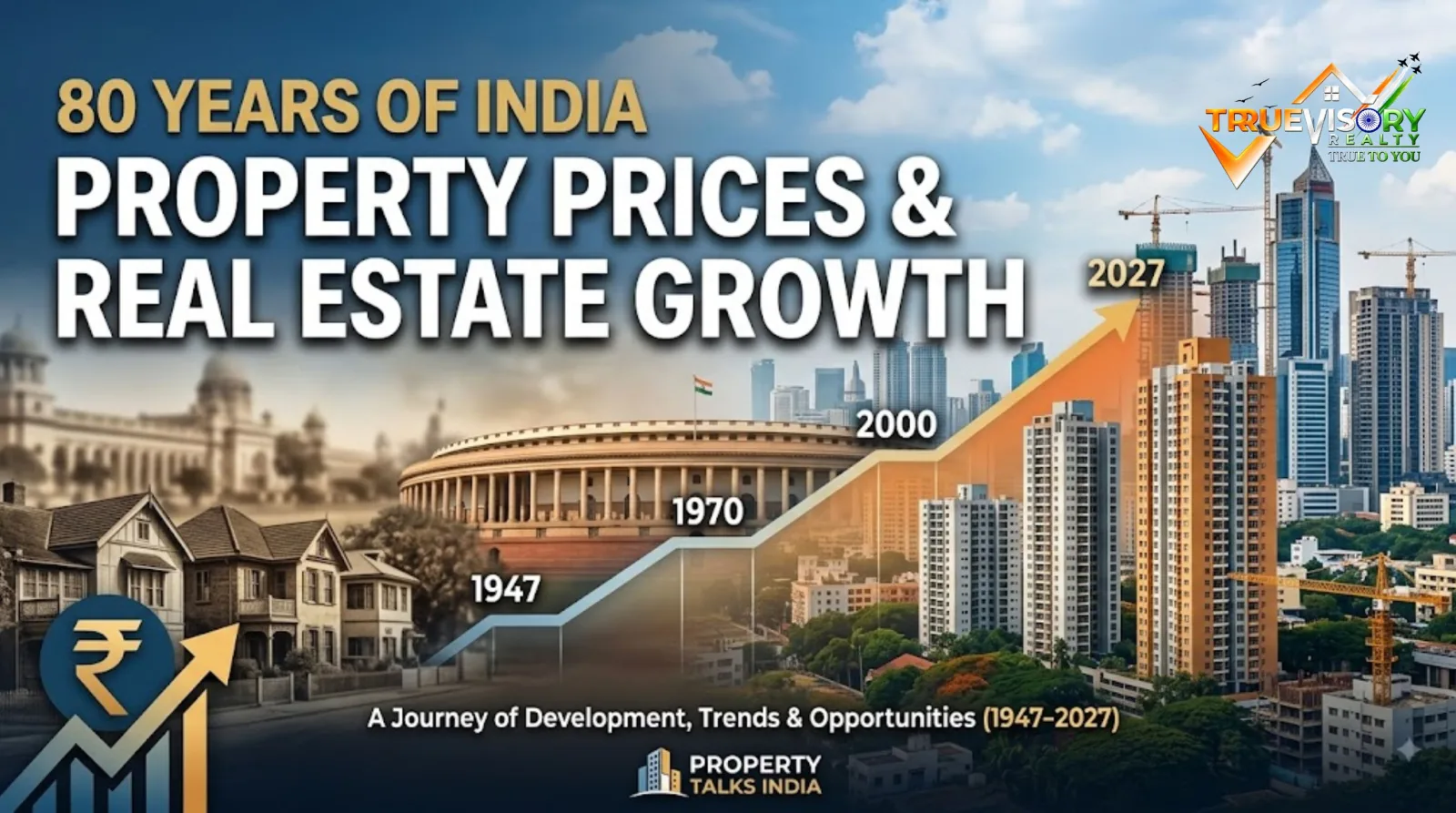
India is celebrating its 80th Independence Day in 2026, marking 79 completed years since 15 August 1947. Over these decades, India has transformed from a largely agrarian economy into one of the world's major economic and urban centres.
One of the clearest ways to understand this transformation is through real estate.
The Indian property market has changed dramatically over the last eight decades. Homes have become larger and more sophisticated, cities have expanded far beyond their traditional boundaries, and land that was once considered peripheral has become part of major residential and commercial corridors.
From Delhi's planned expansion to the rise of Noida, Gurugram, Bengaluru, Hyderabad and other modern business centres, the story of Indian real estate is essentially the story of India's growth.
But how did we get here?
1947: A Newly Independent India and the Beginning of a New Housing Story
When India became independent in 1947, the country's housing and urban infrastructure were nowhere near today's scale.
The government faced enormous challenges, including population displacement, limited resources, inadequate urban infrastructure and the need to develop planned settlements.
According to the Press Information Bureau, the early post-independence period from 1947 to 1964 was marked by limited resources and inadequate capacity for housing and urban infrastructure. However, this period also saw the beginning of state housing boards and planned-city development.
At that time, owning a property was primarily about having a home and securing land for the family.
The concept of buying a property primarily for capital appreciation, rental income or portfolio diversification was not as widespread as it is today.
1950s–1970s: Planned Cities Begin Changing India's Urban Landscape
As India developed, the need for organised urban planning became increasingly important.
Cities such as Chandigarh and Gandhinagar emerged as examples of planned urban development.
Delhi also experienced rapid population growth. The National Capital Region Planning Board notes that Delhi recorded very high decadal population growth rates from the 1950s onwards, creating increasing pressure on land, housing, transportation and civic infrastructure.
This was an important turning point.
As population increased, the demand for:
- Residential plots
- Independent houses
- Government housing
- Rental accommodation
- Roads and transportation
- Commercial markets
also increased.
The connection between population growth, infrastructure and property demand had begun to take shape.
1980s–1990s: The Rise of Urban India
The next major transformation came with the expansion of India's urban economy.
The National Capital Region concept evolved as policymakers recognised that Delhi's growth could not be managed independently from surrounding areas. The NCR Planning Board was formally established under the NCR Planning Board Act in 1985, involving Delhi, Haryana, Rajasthan and Uttar Pradesh.
This regional approach eventually helped create opportunities for cities and areas surrounding Delhi.
The 1990s brought another major change: economic liberalisation.
As private businesses, multinational companies and service-sector employment expanded, demand for modern offices, housing and commercial spaces increased.
Real estate was gradually becoming more than just a place to live.
It was becoming an economic asset.
2000–2010: India's Real Estate Boom
The new millennium brought perhaps one of the most significant transformations in Indian real estate.
Information technology, multinational companies, financial services and modern retail expanded rapidly.
Cities such as:
- Bengaluru
- Hyderabad
- Mumbai
- Delhi-NCR
- Pune
- Chennai
developed new residential and commercial corridors.
The traditional low-rise city began giving way to:
High-rise apartments + IT parks + shopping malls + gated communities + integrated townships
This period also changed the Indian homebuyer's mindset.
A property was increasingly viewed as:
A home today, an investment tomorrow.
For many families, real estate became an important wealth-creation asset.
2010–2020: Infrastructure Became a Property Price Catalyst
By the 2010s, Indian cities were no longer growing randomly.
Infrastructure started becoming one of the strongest factors influencing property demand.
Metro corridors, expressways, highways, airports, business parks and industrial corridors began changing the geography of real estate.
The result was simple:
Connectivity started influencing property prices.
An area located far from the city centre could suddenly become attractive if a new expressway, metro line, airport or employment hub was planned nearby.
This trend continues to shape India's property market today.
Noida: From Planned Industrial City to Real Estate Destination
Noida is one of the strongest examples of how infrastructure and economic development can transform real estate.
What was once a relatively peripheral planned development has evolved into a major residential, commercial and IT destination within Delhi-NCR.
The development of sectors, roads, metro connectivity, expressways and commercial hubs gradually changed Noida's real estate profile.
Today, the market includes everything from affordable and mid-segment housing to luxury residences, commercial offices, retail spaces and mixed-use developments.
The broader NCR story also demonstrates the importance of regional development. As Delhi became increasingly congested, surrounding areas became increasingly important for housing, employment and commercial activity.
2020–2026: The Era of Premium Real Estate
The latest phase of India's real estate journey has been different.
Today's buyers are increasingly looking beyond just four walls.
They are looking for:
- Better connectivity
- Premium amenities
- Larger homes
- Branded developments
- Commercial opportunities
- Rental potential
- Lifestyle facilities
- Future infrastructure
- Long-term appreciation potential
This shift is particularly visible in Delhi-NCR.
According to ICRA, NCR recorded 103 million sq. ft. of residential area sold in FY2025, a decadal high, while sales in H1 FY2026 increased 19% year-on-year. ICRA estimates NCR sales could reach 115–120 million sq. ft. in FY2026.
Even more interesting is the changing preference for premium housing.
ICRA reported that luxury housing accounted for 58% of NCR residential sales by area in FY2025, compared with 24% in FY2021.
This tells us something important:
India's real estate market has moved from simply creating homes to creating aspirational lifestyles.
Property Prices: From Family Asset to Wealth-Creation Instrument
It is difficult to compare property prices from 1947 directly with 2026 because property values vary enormously by city, locality, land quality, infrastructure and property type.
However, the long-term direction is clear.
As India's:
Population → Income → Urbanisation → Infrastructure → Employment
expanded, demand for well-located property also increased.
And when demand increases in locations with limited or valuable land, prices tend to rise.
The modern market provides a good illustration.
A recent Economic Times report citing market data found that Noida residential prices increased by 125% between 2019 and Q2 2026, while Gurugram recorded a 117% increase over the same period.
This does not mean every property or every locality delivers the same appreciation. Instead, it highlights how rapidly selected growth corridors can re-rate when employment, infrastructure and buyer demand come together.
Why Infrastructure Matters So Much for Property Prices
One of the biggest lessons from India's 80-year real estate journey is that infrastructure can change the value proposition of an entire location.
Consider what happens when a new:
Airport + Expressway + Metro + Business Hub + Industrial Corridor
- comes to an emerging area.
- Travel time decreases.
- Businesses become more interested.
- Employment opportunities increase.
- People want to live closer to work.
- Commercial activity expands.
- And real estate demand can follow.
This infrastructure-led model is becoming particularly important in the NCR and other emerging urban corridors. KPMG's 2026 outlook also highlights infrastructure, manufacturing and urban development as important long-term drivers for India's real estate sector.
From Independent Houses to Integrated Developments
Another major change over these 80 years has been the evolution of the Indian home itself.
Earlier
- Independent houses
- Basic neighbourhood facilities
- Limited common amenities
- Smaller organised housing options
Today
- High-rise residences
- Gated communities
- Clubhouses
- Swimming pools
- Fitness centres
- Landscaped spaces
- Smart-home features
- Retail and commercial facilities
- Work-from-home spaces
- Integrated townships
Modern developments increasingly combine living, working, shopping and entertainment within the same ecosystem.
This is why concepts such as mixed-use developments, commercial hubs and walk-to-work destinations are gaining attention.
What Does India's Real Estate Future Look Like?
If the first 80 years were about building cities, the coming decades could be about building smarter, better-connected and more sustainable cities.
India's 2047 development vision places real estate at the centre of housing, workplaces, urban infrastructure and economic development. KPMG highlights areas such as GCC-driven commercial demand, technology, green buildings and improved regulatory systems as important parts of the sector's future.
The next generation of property growth may therefore be influenced by:
1. Airport-led Development
Airports can create new residential, hospitality, logistics and commercial ecosystems around them.
2. Metro and Expressway Connectivity
Better connectivity can bring previously distant locations closer to major employment centres.
3. Commercial Real Estate
Office spaces, retail destinations, IT parks and mixed-use developments can create employment and support residential demand.
4. Tier-2 and Tier-3 Cities
Future real estate growth is not expected to remain limited to India's largest metros. Infrastructure investment and economic decentralisation can create new regional growth centres.
5. Sustainable Development
Energy-efficient buildings, green spaces, water management and environmentally conscious planning are likely to become increasingly important.
From 1947 to 2026: What 80 Years Teach Property Investors
India's real estate journey gives investors an important lesson:
Location matters, but future potential matters too.
A property that appears expensive today may become valuable tomorrow if the surrounding ecosystem develops.
Similarly, a cheap property is not automatically a good investment.
The important questions are:
- Is infrastructure improving?
- Are employment opportunities increasing?
- Is connectivity getting better?
- Is the population growing?
- Is commercial activity expanding?
- Is the developer credible?
- Are legal and regulatory approvals in place?
- Is there genuine end-user demand?
These questions are often more important than simply asking, “What is the current property price?”
India @ 80: From Property Ownership to Property Opportunity
India's real estate story over the last eight decades reflects the country's broader transformation.
In 1947, the priority was building a foundation.
Over the decades, India built cities, industries, roads, institutions and infrastructure.
Today, the conversation has moved towards premium housing, commercial ecosystems, smart infrastructure, investment opportunities and sustainable urban development.
And the journey is far from over.
As India moves towards its centenary of independence in 2047, today's emerging corridors could become tomorrow's established urban centres.
For property buyers and investors, this creates an important opportunity—but also a responsibility to research carefully, understand the location, verify approvals and evaluate long-term fundamentals before investing.
A New Chapter for Indian Real Estate
80 years of independence have changed India.
They have also changed the meaning of property.
A house is no longer simply a roof over one's head.
A well-located property can represent security, lifestyle, business opportunity, rental income and long-term wealth creation.
From the planned neighbourhoods of early independent India to today's high-rise cities and infrastructure-led development corridors, real estate has travelled alongside India's growth story.
As India looks towards 2047, the next chapter could be even more exciting.
The question is no longer just:
“Where are property prices today?”
The bigger question is:
“Where will India's next growth story be built?”
And that is exactly where the future of Indian real estate begins.
Truevisory Realty: Helping Buyers Navigate India’s Changing Real Estate Landscape
India’s real estate market has undergone a remarkable transformation over the past 80 years. Today, buying a property is no longer just about owning a home; it is also about understanding location, infrastructure, future development and investment potential.
This is where Truevisory Realty plays an important role. As a real estate consultancy company in Noida, Truevisory Realty helps homebuyers and investors explore residential, commercial and investment property opportunities while making more informed real estate decisions.
In rapidly developing markets such as Noida, Greater Noida and Delhi-NCR, evaluating a property requires more than simply looking at its current price. Factors such as connectivity, upcoming infrastructure, commercial development, developer credibility, project approvals and future demand can significantly influence a property's long-term potential.
Truevisory Realty focuses on helping clients understand these factors and identify property opportunities that align with their requirements and investment objectives. The aim is not simply to find a property, but to help clients make a well-informed decision based on the broader growth story of the location.
As India moves towards its 2047 vision, emerging corridors across Noida, Greater Noida and the Yamuna Expressway region are expected to remain important parts of the NCR’s evolving real estate landscape. Infrastructure-led development, new business destinations and improved connectivity are creating new opportunities for both residential and commercial real estate.
At Truevisory Realty, the belief is simple: buying property today is not just about buying square feet; it is about positioning yourself in a future growth corridor.
With the right market information, project evaluation and professional guidance, buyers and investors can make more informed decisions as India’s real estate sector enters its next chapter.